Perdu workshop: The Poetics of Absent Spaces
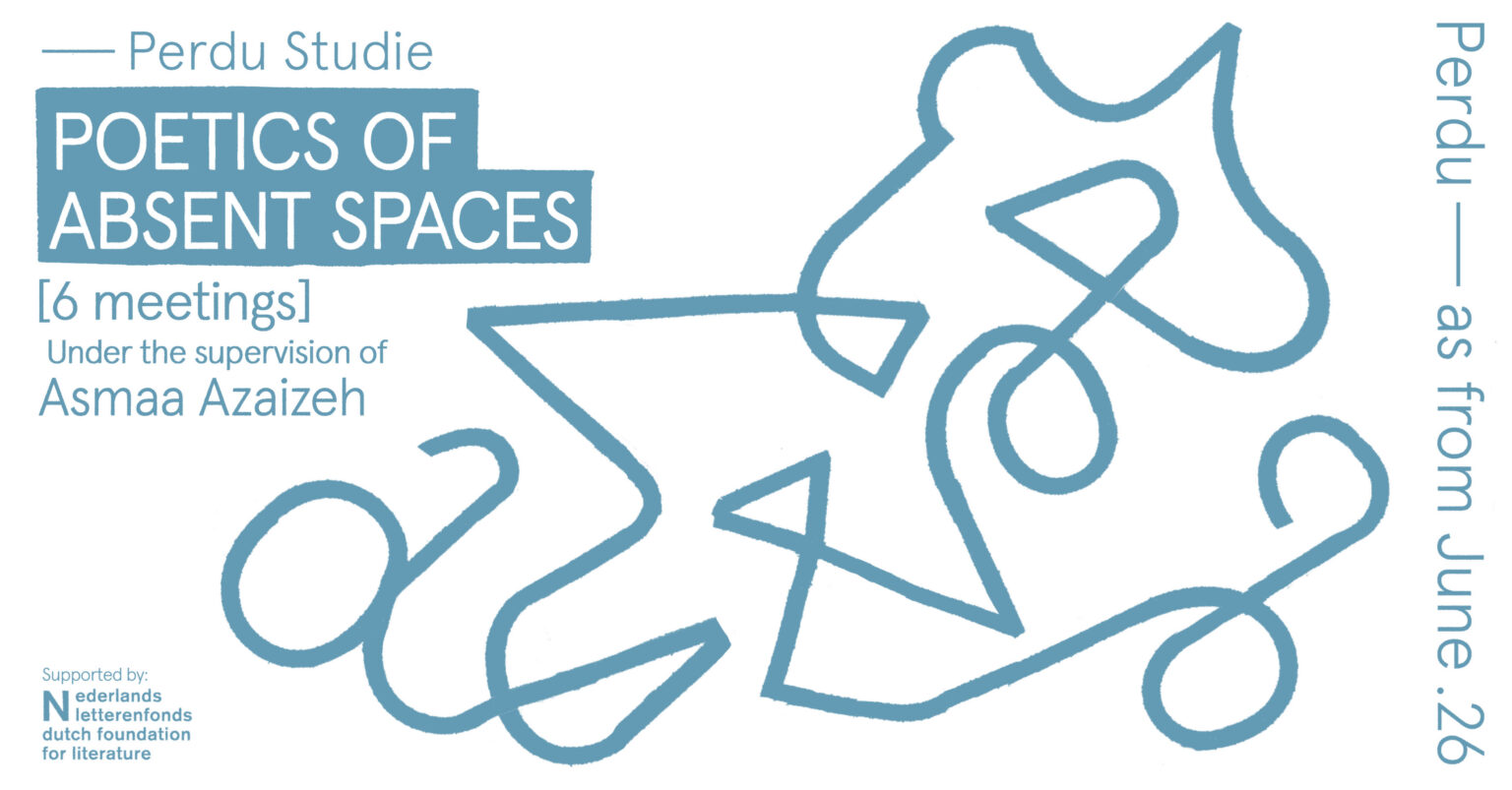
Do we stay who we are when we lose our spaces? And how will such a loss transform our personal identity? Inspired by Gaston Bachelard’s The Poetics of Space, poet and writer Asmaa Azaizeh created this workshop. During The Poetics of Absent Spaces we will explore our absent spaces, those concealed, destroyed, or silenced, whether by political forces, by war, or simply by time and change. We will focus on how absence itself shapes our imagination, and how lost spaces persist in memory, emotion, dreams, and personal history. Through guided writing exercises, we will craft both poetry and prose.
** The Poetics of Absent Spaces is a collaboration with with Read my World Festival 2026 **
Bachelard emphasized how small and intimate spaces – like the attic, a space of hope, or the cellar, a storage of fear – actively shape and structure our emotions. In this workshop, we will expand this idea: absence does not merely affect our imagination; it actively forms and intensifies our emotions, just as the attic and cellar embody distinct hopes and fears.
Fine art, photography, and later cinema have long reimagined, reclaimed, and given presence to moments, memories, and lost spaces. We will see how writing, too, can become a tool for visualizing absence. We will engage in close readings of contemporary poetry and literature that evoke absence, using them as prompts. Through guided writing exercises, we will craft both poetry and prose, giving voice to these absent spaces, from childhood, from personal life, so that, through our words, we also give our own identity a voice. By naming these spaces, we give ourselves back to them, making the absence a place where we reclaim who we are.
AI
As we revisit these spaces, we will collaborate with AI to generate visual reconstructions of these imagined spaces. In this fusion of poetry, prose, and technology, we will ask: does AI, by making these absent spaces visible, awaken a new presence in us? Does this digital reconstruction offer a deeper connection to a lost past, or does it risk becoming another hollow echo? By asking this, we confront the urgency of technology today: what does it mean when we bring absent spaces into presence through digital imagination, and how does this shape how we remember, feel, and act in the world?
Logistics and application
The workshop Poetics of Absent Spaces is made up of six three hour sessions, with reading and writing assignments for each sessions. Four of these sessions will take place at Perdu, Kloveniersburgwal 86 in Amsterdam. The other two will be online sessions.
June 13th, 14:00 – 17:00 (Perdu)
June 20th, 14:00 – 17:00 (Perdu)
July 4th, 14:00 – 17:00 (online)
July 18th, 14:00 – 17:00 (online)
August 20th, 14:00 – 17:00 (Perdu)
August 29th, 14:00 – 17:00 (Perdu)
The workshop will be held in English. Works submitted in other languages will be translated (by the author or by a machine) for feedback.
Total price of participation: €199,00 (ex. 9% VAT)
To apply, please send us a short text before the 1st of June, explaining your motivations for attending this workshop, and your expectations of it. Perhaps you could share some work and tell us something about your artistic practice.
Bio
Asmaa Azaizeh is a London based Palestinian poet, who was born in the Galilee, and has lived until recently in Haifa. Her work moves between page and performance, and is known for its direct, clear-cut language and its refusal to look away from violence, while remaining attentive to fragile forms of hope. Asmaa’s audio visual performances have been staged at leading festivals around the world.
She is an author of four poetry collections and a memoir and received the debutant writer award from Al Qattan foundation for her debut Liwa (Jordan: Al-Ahlia). Her poetry has been translated into many languages. Most recently her collection Don’t Believe me if I talk of war was published in Dutch, Swedish, and French.
